

This half term, our classroom became a magical, language-rich woodland wonderland! The children were surrounded by the sights, sounds, and stories of the forest and autumn, sparking their curiosity and imagination. Together, we explored how the seasons change, looked closely at autumn vegetables, and enjoyed celebrations like Halloween and Bonfire Night — bringing our learning to life in playful and exciting ways.
Through our key stories, Leaf Man and Percy the Park Keeper, the children shared ideas, acted out scenes, and expressed themselves creatively. Their adventures continued in Forest School, where they discovered the wonders of nature, built confidence, and developed new skills through hands-on exploration.
Throughout our woodland theme, the children have shown wonderful curiosity, creativity, and joy as they explored both stories and the beautiful world around them.
Specific Area: Literacy
This half term in Literacy, the children stepped into the magical worlds of The Gruffalo by Julia Donaldson and Owl Babies by Martin Waddell. They listened carefully to the stories, shared their ideas with friends, and acted out the adventures of the characters with great enthusiasm. Through role play, the children became storytellers and actors — stepping into the shoes (or paws!) of the Gruffalo, the brave little mouse, and the fluffy owl babies. These experiences helped build confidence, imagination, and a love for storytelling.
The children also became budding writers, creating their own simple instructions and learning how to put their ideas in order. They labelled the story characters, remembering names, special features, and fun details. Sequencing story events was like solving a puzzle — putting together what happened first, next, and last to make their very own story maps. Storytelling soon became a wonderful adventure as the children discovered how their words could bring characters and stories to life.
Key Questions
Our learning was guided by questions such as:
- How can we sequence a story so it makes sense?
- How can we label characters while following instructions?
- How can we retell a story in our very own words?
These questions encouraged curiosity, creativity, and helped the children grow into confident storytellers.
Phonics Focus
In Phonics, the children focused on Phase 2 sounds, learning to recognise, blend, and segment sounds to read and write simple CVC (consonant-vowel-consonant) words. Daily phonics sessions were full of fun and games — blending sounds to read words, and writing to label characters and objects from our stories. The children loved going on sound hunts in the books, spotting familiar letters and sounds as they explored the stories more closely.
Learning Outcomes
By the end of this unit, the children could confidently retell familiar stories with growing excitement and independence. They sequenced story events like little story detectives, labelled characters and objects correctly, followed simple written instructions, and read and wrote CVC words using their Phase 2 phonics knowledge. Most importantly, they developed a real love of stories — enjoying the magic of reading, writing, and using their imaginations every day!

Specific Area: Maths
In Maths, the children explored the wonderful world of numbers from 1 to 10, starting with 1 to 4. They practiced counting, ordering, and comparing quantities, all while developing their early problem-solving and reasoning skills.
Learning was active and hands-on — the children used real objects, colourful counters, and fun games to help numbers come to life. They investigated how numbers work, spotted patterns, and began to understand how different quantities relate to one another.
Our learning was guided by curious questions such as:
How do numbers work from 1 to 10?
How can we compare quantities?
Through these playful experiences, the children grew in confidence and began to think like little mathematicians — exploring, discovering, and enjoying the magic of how numbers fit together!

Specific Area: Understanding the World
This half term, the children explored homes from around the world, discovering the many different and wonderful ways people live. They looked at houses made from wood, clay, bricks, and even ice — noticing how each home is special and suited to where people live.
The children also learned about crowns and celebrations, finding out how different cultures and communities mark special occasions with joy and colour. Together, we talked about the “jobs” that different hats do — from woolly hats that keep us warm, to bike helmets that protect our heads, and crowns that show importance and celebration.
As young explorers, the children observed seasonal changes, noticing how the world around them transforms with the weather and the passing months. They became little scientists too, investigating how materials can change — bending, stretching, and exploring how different objects can transform through simple hands-on experiments.
Our learning was guided by thoughtful questions such as:
- What is a home?
- What is a crown?
- How do people celebrate?
- How do the seasons change?
- How do materials change?
Through these rich and playful experiences, the children developed their curiosity, observation skills, and understanding of the world around them — all while enjoying the wonder of learning through discovery and exploration.

Specific Area: Expressive Arts and Design
This half term, the children have worked creatively through music, art, and design technology. They have listened carefully to different types of music and let their bodies dance, wiggle, and move freely — exploring how sounds can make them feel happy, excited, calm, or even a little silly!
The children have enjoyed their mark-making and drawing skills as they have experimented with colours, shapes, and lines to bring their wonderful ideas to life.
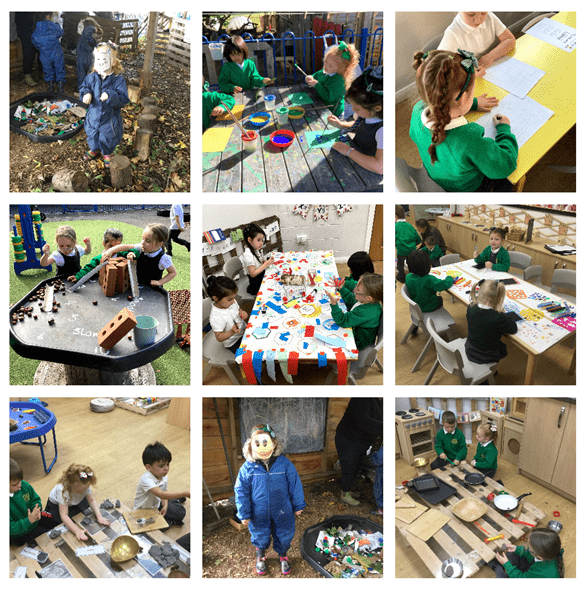
The junk modelling station has had a fun new makeover, making it easy for the children to choose just the right recycled materials for their creations. The children have eagerly got stuck in, exploring, experimenting, and building some absolutely amazing structures. Everyday objects were transformed into rockets, castles, crowns, and all sorts of imaginative inventions!
Our learning was guided by creative questions such as:
- How can we express ideas through music, art, and design?
- How can we turn recycled materials into something new?
Through these hands-on experiences, the children grew in confidence, imagination, and problem-solving skills — and most of all, they loved watching their ideas come to life!
Prime Area: Personal, Social and Emotional Development
This half term, the children developed their understanding of how to care for themselves and for one another. They explored what it means to build positive relationships, celebrate differences, and appreciate the special qualities that make each person unique.
Over the half term, the children practised kindness in many ways — learning how to listen to others, offer help, share, and celebrate their friends’ achievements. They also learned about the importance of staying safe, both indoors and outdoors, and thought carefully about how to look after themselves and others in different situations.
Our discussions included learning about rights and responsibilities — understanding that everyone has the right to feel safe, respected, and valued, while also recognising how their own actions can help protect those rights for others.
These ideas came to life during Forest School, where the children had plenty of opportunities to put their learning into practice in the great outdoors. They built resilience, problem-solving skills, and confidence as they worked together, took on new challenges, and explored the natural world.
Our learning was guided by thoughtful questions such as:
- How do we look after ourselves and each other?
- How can we be kind and celebrate one another?
- How can we stay safe?
- How can we respect our own rights and the rights of others?
Through these meaningful experiences, the children grew in confidence, empathy, and independence — developing a wonderful sense of belonging, teamwork, and adventure as they supported one another and explored the world around them.
Prime Area: Physical Development
This half term, the children developed their coordination, control, and strength through a range of fun, active, and engaging experiences. They took part in exciting obstacle courses, lively PE games, and daily movement challenges that helped to strengthen both their fine and gross motor skills.
Our learning was inspired by the colourful story of Elmer, which encouraged the children to move with imagination and teamwork — just like Elmer and his friends! Through playful activities, they explored how to move safely and confidently, practising their balance, jumping, climbing, stretching, and coordination in different ways.
Our learning was guided by thoughtful questions such as:
- How can we develop coordination, control, and strength?
- How can we move safely and confidently?
Through these joyful experiences, the children grew stronger, more coordinated, and full of confidence — enjoying every opportunity to move, explore, and have fun while discovering what their amazing bodies can do!

